


Engitec recently took part in the 10th International Secondary Lead Conference (ISLC) and its associated Lead Training Academy, in Colombo, Sri Lanka.
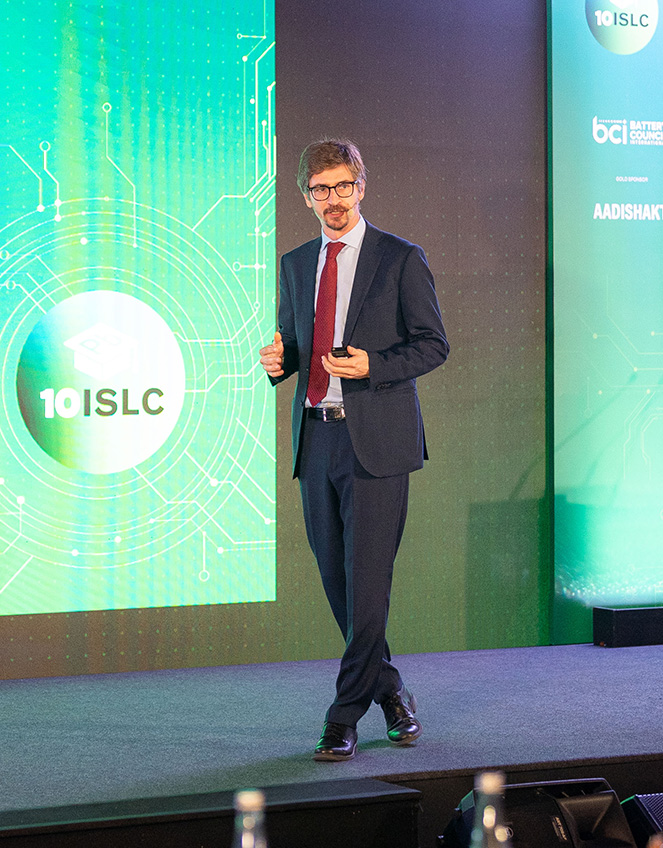
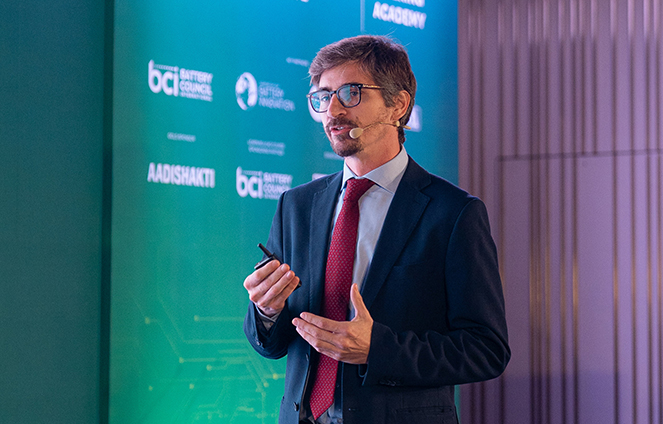
During the event Daniele Silla, our Commercial Manager, delivered two complementary presentations: one on the strategic importance of recovering valuable materials beyond lead, while the other served as a training session on the processes behind lead-acid battery recycling.
THE VALUE OF CRITICAL METALS IN ULAB
The speech “Elevating battery recycling beyond lead extraction: the strategic importance of critical metals recovery” explored how used lead-acid batteries (ULAB) can support a broader recovery strategy: alongside lead and polypropylene, they contain tin, antimony, valuable heavy plastics and electrolyte streams with further recovery or reuse potential.
Maximizing value recovery from each battery can help recyclers mitigate exposure to lead price fluctuations, while optimizing scrap purchasing costs and processing costs.
Through its proprietary technologies, Engitec outlined concrete recovery pathways for tin and antimony, through separation, refining, and subsequent treatment, including vacuum distillation for tin.
Furthermore opportunities to upgrade valuable heavy plastics and the potential to reuse electrolyte in new batteries were highlighted. Product quality, market access, and process configuration determine how these opportunities translate into commercial value.
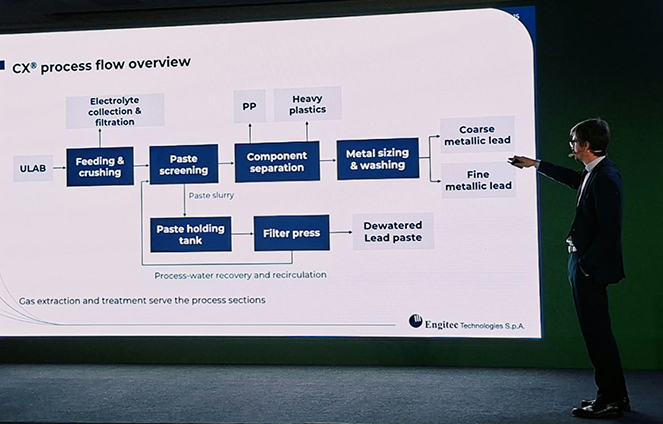
The proprietary CX® Breaker was presented as the starting point for multi-material recovery. Separating battery components into distinct, cleaner fractions optimize downstream processing. While metallic fractions can be fed directly to refining, where tin and antimony are selectively removed for subsequent recovery, lead paste is treated in rotary furnaces to produce soft lead.
THE LEAD TRAINING ACADEMY
The Lead Training Academy was designed to introduce a new audience to the industry, bringing together representatives of associations, NGOs, and authorities, alongside young talents entering the sector.
In his presentation “Inside lead-acid battery recycling”, Daniele Silla made the fundamentals accessible to newcomers, explaining three key process areas:
- Battery breaking and separation: crushing, screening and density-based separation recover electrolyte, plastics, lead paste, and metallic lead, with further screening dividing the metal into coarse and fine fractions.
- Paste desulfurization: treating the paste with soda ash or classic soda transfers sulfur into sodium sulfate solution. This process drops paste sulfur content from 6–7% to below 1%, minimizing sulfur oxide emissions and slag formation during smelting.
- Sodium sulfate crystallization: solution purification, crystallization, centrifugation, and drying produce saleable sodium sulfate powder. Reusing the resulting supports the Zero Liquid Discharge (ZLD) targets.
The session concluded by addressing emissions and resource efficiency, productivity and operating costs, highlighting the role of automation, data collection and potential AI applications for process monitoring and optimization.
SHARING KNOWLEDGE FOR A SUSTAINABLE FUTURE
Together, the two presentations connected the industrial case for multi-material recovery with the process knowledge needed to support it.
Expanding the product portfolio strengthens recycling economics and returns more materials to use, while facilitating the quantification of long-term environmental gains.
For Engitec, technology development and knowledge sharing are complementary drivers to a more circular secondary lead industry.
Engitec would like to thank the organizers, partners and all participants who contributed to the success of the event and to building a more efficient and responsible future for lead-acid battery
